Alberta did not vote to join Canada. Canada created the province of Alberta. But the province wasn’t empty. Americans had moved in wanting to escape American government. If they had been asked for becoming a province of Canada, there is no answer to give. They were there and they weren’t going to leave.
On July 20, 1905, Parliament established Alberta from part of the Northwest Territories. There was no referendum in which an existing Alberta nation chose Canada. Alberta began as a Canadian province, created as part of a national project to settle and develop the West.
That history matters because, more than a century later, Alberta increasingly speaks about itself in the language of a political nation: our money, our resources, our pension, our police, our laws, our future.
How did a Canadian province develop such a powerful sense of political distinctiveness? It didn’t just happen because of Pierre Trudeau or Justin Trudeau or the federal Liberal party. History tells us otherwise.
The historian Nelson Wiseman identified an unusually strong American influence on Alberta politics: rugged individualism, market capitalism, equality of opportunity, suspicion of centralized government and socialism, and the ideal of the self-made individual.
The federal government actively recruited settlers to the West with the promise of land, opportunity, independence and self-reliance. Canada wanted people who would build farms, communities and businesses. It succeeded.
But the political culture encouraged by that settlement strategy was not necessarily comfortable with the national government that had made the settlement possible.
The result was a distinctive Alberta political temperament.
It is my land. It is my work. Why should government take my money? Why should someone else tell me what to do?
Those sentiments have persisted. Over time, the individual became the taxpayer, the taxpayer became the producer, and the producer became Alberta.
The question “Why should government interfere with me?” gradually acquired a provincial form:
“Why should Ottawa interfere with Alberta?”
That transformation is central to understanding Alberta today.
It also helps explain why Alberta’s political history cannot be reduced to separatism. Alberta has produced Social Credit, the United Farmers, Progressive Conservatives, Reform, the Wildrose movement and the modern United Conservative Party. These movements differed enormously. Yet beneath the differences ran a recurring concern with individual freedom, property, taxation, economic independence and resistance to centralized authority.
The political institutions changed. The vocabulary changed. The underlying instinct proved remarkably durable.
And this is where Danielle Smith’s political history becomes significant.
Smith did not invent this political culture. She emerged from it. Her political formation took place in the conservative intellectual environment of the University of Calgary, the Calgary School, the Fraser Institute, property-rights politics and the Wildrose movement. Her career moved through institutions and movements that emphasized individual liberty, free markets, limited government, property rights, and resistance to federal intervention. Tom Flanagan, one of the most influential figures in that intellectual world, later managed Smith’s 2012 Wildrose leadership campaign.
The importance is that the same political values associated with Alberta’s formative American influence were being reproduced, intellectually developed and transmitted through Alberta’s modern conservative institutions.
The frontier settler’s political instinct did not disappear when the frontier disappeared. It acquired think tanks. It acquired universities. It acquired political parties. It acquired radio and television personalities. It acquired policy papers. And eventually it acquired a premier.
It explains why the politics of individual autonomy can become politics of provincial autonomy. It also explains why the language of grievance so often points outward.
Why should Ottawa take Alberta’s money?
Why should Ottawa control Alberta’s resources?
Why should Alberta pay for provinces that contribute less?
Why should Ottawa tell Alberta how to run its economy?
These are legitimate political questions. But they are incomplete questions.
A federation cannot be understood simply by calculating what one province sends to Ottawa. It has to be understood by examining what each level of government does, what each receives, what each contributes and what each is responsible for. That is the part of the Alberta conversation that is often missing.
The political argument can become a ledger of grievances against Ottawa without an equivalent ledger of Alberta’s own decisions. This does not make Alberta’s grievances illegitimate. It makes them incomplete.
The distinction matters because Alberta’s current political project goes considerably beyond the traditional complaint that Ottawa is meddling too much.
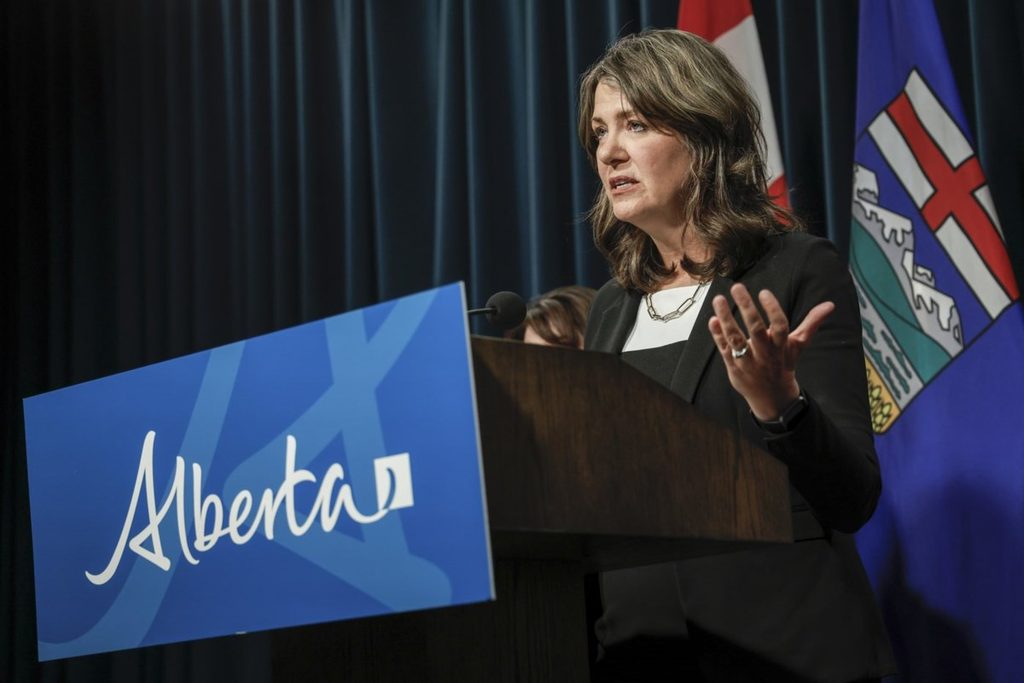
Danielle Smith describes her objective as a sovereign Alberta within a united Canada.
The more useful question needs to ask what powers Alberta seeks.
Alberta has examined greater provincial control over taxation, resources, pensions, policing, immigration, social programs and international agreements. The Sovereignty Within a United Canada Act provides a mechanism for the province to resist federal measures it considers harmful to Alberta.
None of this automatically means independence. A province can demand greater autonomy while remaining a province. But there is a constitutional question hiding underneath the terminology.
If Alberta eventually controls its own income-tax collection, substantially reduces federal authority over its resources, establishes its own major social programs, pursues its own international economic relationships, controls more policing and immigration functions, and increasingly treats federal legislation as something Edmonton may accept or reject, what remains of the practical authority of the federal government in Alberta?
America has always been in the room
There is another part of this story that Canadians should understand. America did not suddenly return to Alberta.
America has always been in the Alberta story.
It was there among the early settlers. It was there in the political ideas that helped shape the province. It was there in Alberta’s economic dependence upon American markets. It was there in the circulation of conservative and libertarian ideas through organizations and intellectual networks. And it remains there now.
The difference is that the relationship has become more politically consequential. American political networks have developed relationships with Alberta activists and political organizers. Reporting has documented contacts between Alberta separatist figures and American Republican operatives. Other reporting has examined efforts by Alberta advocates to cultivate relationships in Washington and to present Alberta’s resources as strategically valuable to the United States.
That does not establish an American government conspiracy to break up Canada.
It does establish something less dramatic but more important: Alberta’s political struggle is occurring in a North American political environment in which American interests have a direct stake.
And the current American administration has made that environment substantially more dangerous. Donald Trump has repeatedly spoken of Canada as a potential 51st state and has used tariffs as an instrument of pressure against Canada.
For Alberta, this creates an extraordinary contradiction.
The United States is Alberta’s largest external economic partner. Alberta’s political culture has long been unusually receptive to American ideas. Yet the American president is simultaneously challenging Canadian sovereignty. So, what happens when Alberta’s economic interests, Alberta’s political identity and Canada’s national interest do not point in precisely the same direction?
That question became visible during the tariff dispute. Smith has emphasized protecting Alberta and has said she will always put Albertans first. That is understandable provincial politics.
But Canadians are entitled to ask what Canada first means when Canadian sovereignty itself is under pressure. If the United States threatens Canada, is Alberta’s first political
Alberta developed a political culture in which individual independence became a defining virtue. That culture was reinforced by an American influence that was unusually strong during the province’s formative years. Canadian governments helped create the conditions in which that culture flourished. Alberta’s conservative institutions later refined it and turned it into a sophisticated political philosophy.
Today, that philosophy is being applied not simply to the individual but to the province itself.
My property became our resources.
My money became Alberta’s money.
Leave me alone became leave Alberta alone.
The October referendum question is therefore about more than whether Albertans like Ottawa. It is about whether Alberta’s long demand for autonomy has reached the point where many Albertans are prepared to ask whether autonomy is possible without sovereignty.
Can Alberta remain part of Canada while substantially reducing Canada’s authority within Alberta? Can a province demand control over taxation, resources, pensions, policing, immigration and international economic relationships while retaining the benefits and protections of Canadian nationhood?
And if the answer is yes, what does that Canada look like?
Those questions belong to Albertans. But they also belong to every Canadian. Because Alberta did not enter Canada as a sovereign country. The Canadian state created the province in 1905.
For more than a century, Alberta has developed its own political identity within that federation. Now that identity is strong enough to challenge the terms of the relationship that created it.
Why is Alberta angry?
It is:
How far does Alberta want its independence to go?